If your Check Engine Light turns on, it’s normal to feel a little worried. Sometimes it’s something small. Sometimes it’s not. But guessing usually wastes time.
An OBD2 scanner is a tool that helps you stop guessing. It connects to your car and reads the information your car has already saved about a problem.
Think of it like this: your car’s computer notices something “not normal,” and the scanner helps you see what the computer is complaining about.
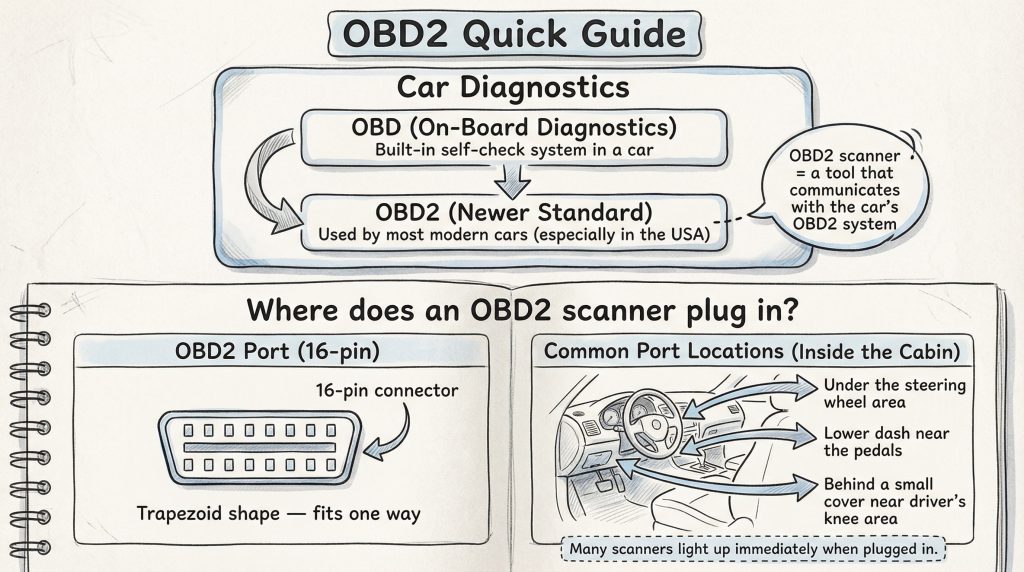
What does “OBD2” mean?
OBD stands for On-Board Diagnostics.
It’s basically a self-check system built into the car.
OBD2 is the newer standard that most modern cars use (especially in the USA). So when people say “OBD2 scanner,” they mean a scanner made to talk to that system.
Where does an OBD2 scanner plug in?
It plugs into the OBD2 port (a 16-pin connector). The port is usually inside the cabin, not under the hood.
Most of the time you’ll find it:
- under the steering wheel area
- around the lower dash near the pedals
- sometimes behind a small cover near the driver’s knee area
The port has a slightly “trapezoid” shape, so the plug only fits one way.
When you plug the scanner in, many scanners will light up right away.
What is the ECU?
Your car has a main computer that controls and monitors a lot of things. People often call it the ECU (and some cars call it the ECM).
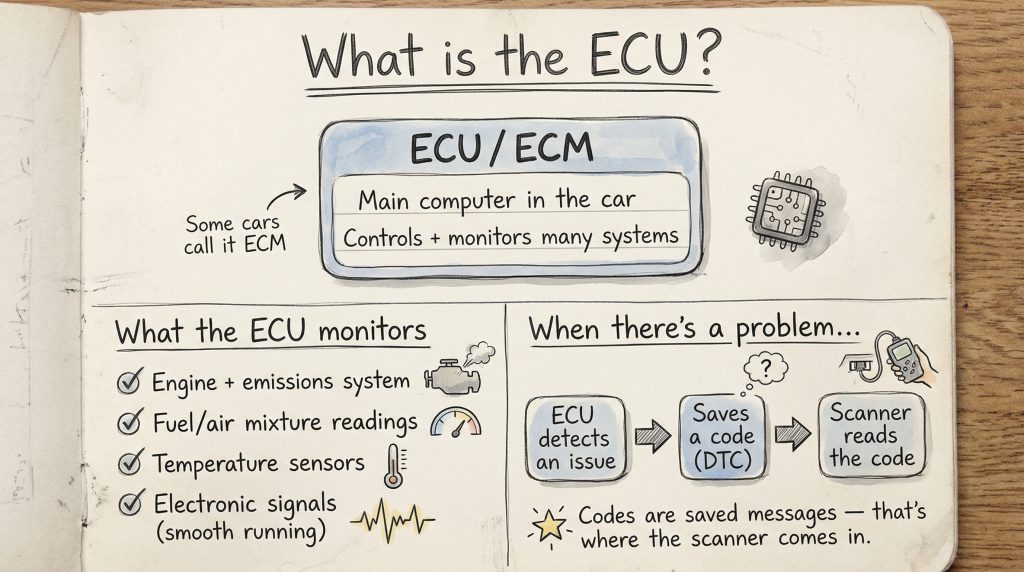
This computer keeps an eye on sensors and systems like:
- the engine and emissions system
- fuel/air mixture readings
- temperature sensors
- various electronic signals that help the car run smoothly
When the ECU sees a problem, it saves a message in the form of a code. That’s where the scanner comes in.
What does an OBD2 scanner actually read?
Most scanners focus on a few useful types of info. You don’t need to learn everything on day one—you just need to know what you’re looking at.
Trouble Codes (DTCs)
These are the codes stored when something triggers a warning light. Many codes look like P0xxx. You don’t need to memorize them. The code is more like a “clue” that points you in the right direction.
Live Data
Some scanners can show real-time readings while the car is running. This is where you’ll see numbers changing as the engine runs—helpful when you’re trying to understand what the car is doing right now, not what happened last week.
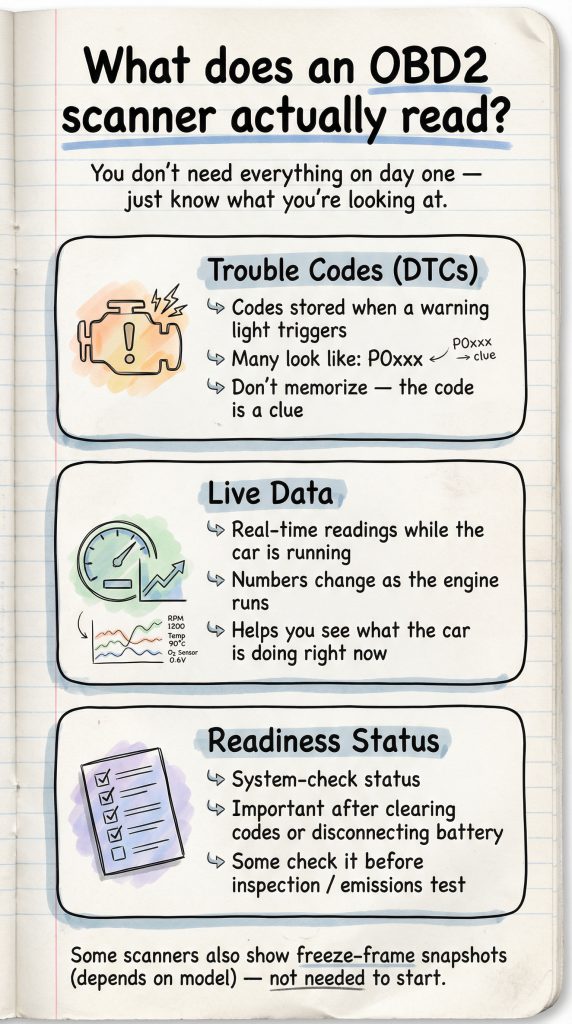
Readiness Status
This is a “system check” status that can matter after you clear codes or disconnect the battery. Some people check readiness before inspection or emissions testing.
Some scanners may also show extra things like freeze-frame style snapshots (depends on the model), but you don’t have to worry about that to get started.
How does an OBD2 scanner work?
It’s simpler than people think.
You basically:
- plug it into the OBD2 port
- turn the ignition on (or start the car, depending on the scanner)
- the scanner communicates with the car’s computer
- it pulls stored codes and data
- it shows the results on the screen or in an app
That’s it. No magic. It’s just reading what the car already knows.
What do people use an OBD2 scanner for?
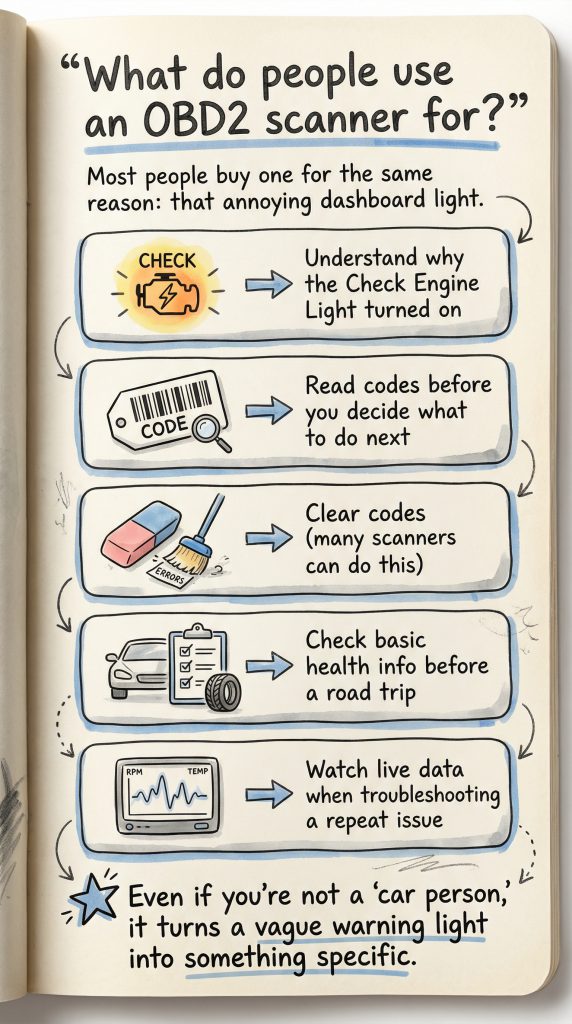
Most people buy one for the same reason: that annoying dashboard light.
A scanner can help with things like:
- understanding why the Check Engine Light turned on
- reading codes before you decide what to do next
- clearing codes (many scanners can do this)
- checking basic health info before a road trip
- watching live data if you’re troubleshooting a repeat issue
Even if you’re not “a car person,” it’s helpful because it turns a vague warning light into something more specific.
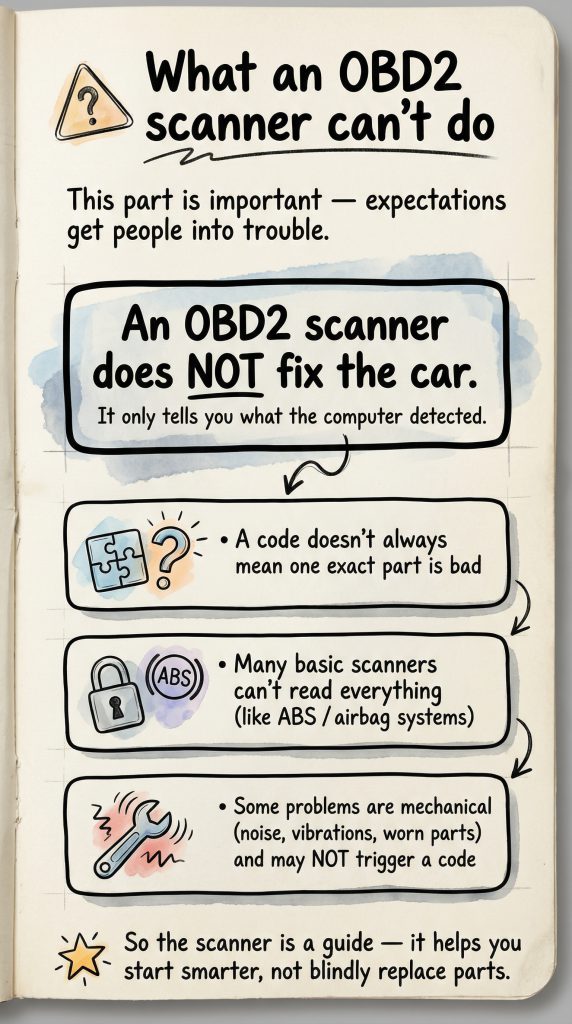
What an OBD2 scanner can’t do
This part is important—because expectations get people into trouble.
An OBD2 scanner does not fix the car by itself. It only tells you what the computer detected.
Also keep this in mind:
- A code doesn’t always mean one exact part is bad
- Many basic scanners can’t read everything (like ABS/airbag systems)
- Some problems are mechanical (noise, vibrations, worn parts) and may not trigger a code at all
So the scanner is a guide. It helps you start smarter, not blindly replace parts.
Quick beginner tip
If you’re new to this: don’t panic when you see a code. Read it, look up what it means, and then decide whether it’s safe to keep driving or if it needs attention right away.
If you’re planning to buy one, choose something simple that clearly explains codes and is easy to connect—beginner-friendly matters more than fancy features at the start.
Conclusion
An OBD2 scanner is a small diagnostic tool that plugs into your car’s OBD2 port and reads information from the car’s computer (ECU). It can show trouble codes, basic data, and system status so you can understand what’s going on—especially when a warning light appears.
It won’t repair the car for you, but it does help you figure out what to check next, and that alone can save time, stress, and money.